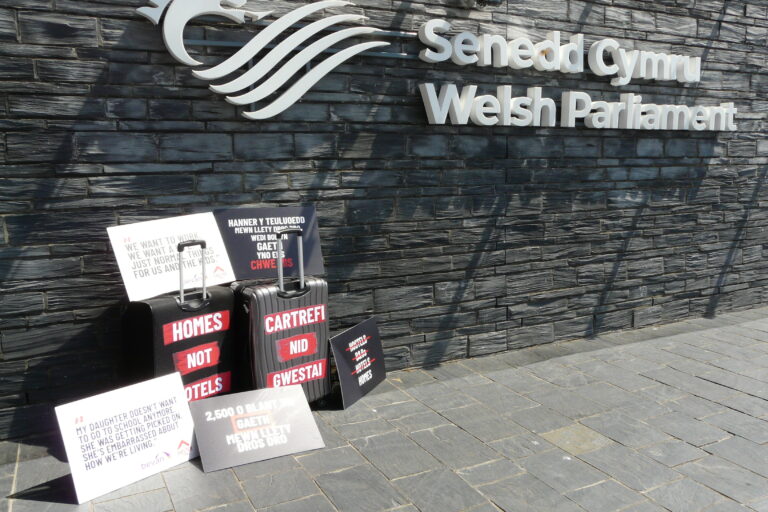
Ending the housing emergency isn’t easy. Beyond the relentless work of the housing and homelessness sector, it requires a mixture of financial investment, policy change, and sustained, cross-government political will.
Promisingly Wales has made significant progress over the years, with key legislative changes like the Housing Wales Act and Renting Homes Wales Act and commitments such as the 20,000 social homes target. One area that has long been a challenge though is securing the level of investment necessary to both tackle homelessness and to prevent it. Shelter Cymru understands that finding the funding for every issue that the Welsh Government faces is difficult. However, the case for investing in ending the housing emergency is incredibly powerful, with access to a safe, secure, suitable and genuinely affordable home being a fundamental aspect of enabling Wales to thrive.
Our homes are the foundations of our lives so investing in ending the housing emergency will help people to access education and employment opportunities, improve physical and mental health outcomes, and provide lasting benefit for future generations.
Given this, the publication of the draft Welsh Budget for 2025/26 is an important moment. It gives us an indication as to whether welcome commitments made in the Ending Homelessness Action Plan will be backed with the financial support needed to make them a reality.
Will the draft budget provide the investment needed to make progress on ending the housing emergency?
Inevitably, the Draft Budget is a mixed picture. However, the additional £81 million of investment into social housing grant funding is clearly a step in the right direction, as is the £21 million uplift to the Housing Support Grant (HSG). Services provided via HSG play a vital role and the investment shows a commitment to making practical support available to those who need it to access or maintain a stable home.
But the decision not to increase all grants provided for homelessness prevention is concerning – and will weaken preventative measures that keep people out of homelessness in the first place. Measures such as help challenging illegal evictions, advice on rights that enables people to keep homes that are at risk, representation in court, and advocacy with other services.
To prevent homelessness we need a range of interventions – the HSG cannot, and does not, operate in isolation from other forms of homelessness prevention. Indeed, in 2023/24 the largest block of referrals into Shelter Cymru’s specialist housing advice services came from HSG funded projects. Yet the indication from the draft budget announcement is that the only grant being uplifted within the Homelessness Support & Prevention budget line is the HSG. This will have consequences.
It must also be noted that the £81m investment in the delivery of new social homes, whilst again a welcome step, does falls short of the level that Audit Wales identified as needed to deliver 20,000 social homes by the end of 2026. Delivering these homes – and planning beyond the 2026 target – is vital. For example, poor quality housing is estimated to cost NHS Wales £95 million per year, with the overall cost of inadequate housing for Welsh society at £1 billion per year.
The impact of the draft budget on homelessness prevention advice
For Shelter Cymru the potential for no increase in the Homelessness Prevention Grant (HPG) – a pot of funding contained in the same budget line as the Homelessness Support Grant – is deeply concerning. Most of our advice services across all local authorities in Wales are funded through this grant.
Cash flat funding for the HPG in 2025/26 (a real terms funding cut) would mean reduced investment in homelessness prevention advice for two consecutive years. And this is reduced investment at a time when homelessness has risen, with the number of households in temporary accommodation increasing by 44% between March 2022 and March 2024. Alongside this private rents in Wales continue rising faster than inflation, Shelter Cymru are seeing an increase in homeowners seeking advice for mortgage arrears, and nearly 30k households are living in overcrowded homes.
In the past 12 months we have seen the impact reduced funding has on Shelter Cymru’s ability to help the people of Wales. Whilst we are proud to have provided advice to 1 in every 113 households in Wales we simply couldn’t support all those who needed help, or help the same numbers as the prior year. This worries us because we know that our advice works. Last year, in homelessness cases with a known outcome, we successfully helped people avoid homelessness 88% of the time and in 59% of cases were able to keep people in their original homes.
We estimate that the impact of cash flat HPG funding, coming alongside increases to National Insurance, will mean 360 fewer households have access to expert advice next year. And that risks higher levels of homelessness than might otherwise have been seen.
This is why we are calling on the Welsh Government to review its draft budget and ensure that all forms of preventative advice receive the funding they need. With an aim to at least maintain current service levels
Even if this meant uplifting the entire Homelessness Support and Prevention budget line by the same percentage as the Homelessness Support Grant, we estimate that it would cost less than £2 million.
Conclusion
The Welsh Government has a long stated ambition to end homelessness and has talked regularly about the importance of both prevention and housing supply in making this a reality.
This is language we welcome, and we’ve called regularly for a cross-government strategy for home that recognises the impact the housing emergency has across policy areas. Whether it is health and wellbeing, education, or the economy, we know poor housing and the financial cost of homelessness is holding Wales back. Investing in delivering new social homes and in other measures is vital to changing this, but long-term solutions must sit alongside help for those who are suffering the impact of the housing emergency today. Maintaining access to specialist housing advice and advocacy for the people of Wales is central to this.
This is not to say the draft budget does not have positive elements that are aligned with our, and the Welsh Government’s, commitment to ending homelessness. But the budget is inconsistent in its approach to vital interventions to prevent homelessness and we believe it could, and should, go further in addressing the housing emergency that we currently face.
You can read our pre-budget submission to the Finance Committee here.
You can find the detail of the Draft Budget here.