Ending the housing emergency in Wales is a significant and complex challenge. It’s something that requires a whole system approach to address issues with welfare, the private rented sector, our approach to homelessness and the support needed to help first-time buyers. But above all else it’s a challenge that requires a significant delivery of social homes because all potential routes to end the housing emergency centre on social homes.
At Shelter Cymru we are not alone in this belief, it’s one we share with the Welsh Government who at the start of this Senedd term committed to delivering 20,000 low-carbon social homes. A commitment that aligned with our calls to increase social housing delivery to 4,000 homes per year during the 2021 – 2026 Senedd term.
Committing to a significant number of social homes is, however, far easier than delivering them. Something that is especially true when the period in question includes the long-term economic impacts of the Covid-19 pandemic, a spike in inflation and dramatic increases in the cost of building homes in general. Despite this the Welsh Government has continued to increase investment and to diversify its approach, including putting more money into the acquisition of existing homes through its successful Transitional Accommodation Capital Programme (TACP).
With the next Senedd election firmly on the horizon the question of whether the government will meet its target has been increasingly raised, and the recent publication of the 2024/25 affordable housing provision data gave us the final chance to look at pre-election progress.
Key takeaways
1. Credit where it’s due
Firstly, the Welsh Government deserves significant credit for the progress that has been made, with delivery of affordable homes up 12% in 2024/25. This brings the total number of homes delivered during this Senedd term to 13,399 – an average of around 3,300 homes per year.
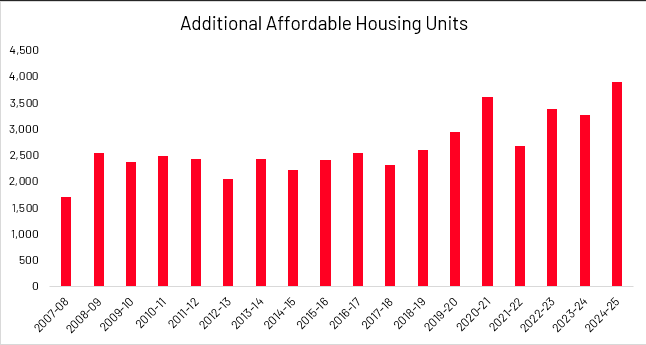
At a time when affordable housing targets in places like London are being reduced the fact that in Wales delivery is increasing is something we need to celebrate. And the commitment shown by the Welsh Government in continuing to increase investment over a number of years is hugely welcome.
However, we can’t ignore the fact that despite the success we’ve seen there is still a shortfall of 6,601 homes, around double the average number delivered per year so far.
Despite this the Welsh Government remains confident it can close the gap and has taken the unusual step of publishing forward projections to demonstrate this. Based on those projections (which should be treated with caution given the nature of housebuilding) the 20,000 targets would be met by the end of the 2026 calendar year.
While it might be fair to have previously interpreted the target as being by the end of the Senedd term if these projections are accurate then, again, the Welsh Government does deserve credit for the success it has delivered.
2. The focus on social rent is welcome
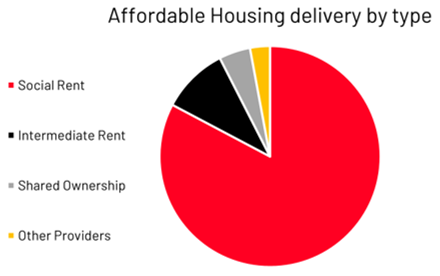
Affordable housing delivery statistics cover a range of different affordable housing products, including:
- Homes for social rent
- Homes for intermediate rent
- Homes for shared ownership
This is important because these three products are quite different to one another and while all meet a technical definition of ‘social housing in the rented sector’ it’s fair to say that social rent is the product most commonly associated with the idea of social homes. And it’s also the one that Shelter Cymru is most interested in.
One of the reasons for this is that social rent isn’t just defined by the cost of the rents it provides, although these are generally cheaper than either market or intermediate rents. In reality it’s a wholly different product, one that provides long-term safety and security. This is something social housing tenants themselves say better than anyone else, and our recent blog sharing Karen’s story does just that. As do these words from Tina in the foreword of our Waiting for a Home report:
“When I finally received the news that a home was available for us, the sense of joy was overwhelming… Having a social home has made such a difference to the health and wellbeing of myself and the children. We have the security of a secured tenancy and are not living under the cloud of high rent rises. We’ve been able to keep our dogs, which has made such a difference to our lives. The high-quality housing we have ensures our safety and means we can plan for the future.”
In England, over a significant period of time, delivery of affordable housing has skewed heavily towards shared ownership and intermediate rent. The reason for this is simple: those products require less subsidy to build as they are more profitable for the landlord. However, when it comes to tackling the housing emergency the product that’s most relevant is social rent.
However, in Wales, unlike England, the government has put in place a system that enables a focus on delivery of homes for social rent. Thanks to this, in 2024/25, 2,921 of the homes delivered were for social rent.
3. Transparent data is vital
When giving evidence to the Senedd Local Government and Housing Committee in 2024, one thing Shelter Cymru highlighted was the importance of seeing affordable housing targets as a KPI rather than an objective. One of the reasons we raised this was a concern that the very existence of a target can skew the data that’s then published. But we need the right data to ensure we have a clear understanding of the scale of the challenge and the further steps needed to deliver the outcome we all want: an end to the housing emergency in Wales.
With this in mind there are elements of the latest publication that should be looked at in more detail. Notably the decision to begin classifying existing social homes that were vacant for the long-term as new social homes and including them in the data.
This decision is the result of a recommendation from the Affordable Housing Taskforce, which said that where properties are bought back into use thanks to TACP funding they should be considered as acquisitions. Our colleagues at the Bevan Foundation have published a blog looking at this (and at what gets included against the 20,000 target in more detail). However, the key point is that this approach risks double counting, with homes that are already included in the stock of social homes being considered as additions to it.
It’s important to say that Shelter Cymru fully supports the use of TACP funding to enable long-term vacant homes to be bought back into use, and the Welsh Government has rightly made it clear how many homes within the overall number delivered fall into this categorisation.
That said, the decision to count the homes in this way is likely to be a controversial one and is something worth revisiting in future data releases.
4. We need investment and policy commitment now to secure the pipeline for tomorrow
In our Waiting for a Home report, we used a series of Freedom of Information requests to build a picture of the demand for social homes in Wales. From that work we were able to estimate that there are currently more than 94,000 households in Wales on waiting lists for a social home. This underlines the scale of the challenge we face, as we estimate that (based on 2023/24 delivery figures) it would take more than 35 years to build the number of homes we currently need.
This is why we need a pipeline for new homes that goes well beyond 2026, one that ensures the delivery of social homes continues to increase each and every year until we reach the point where everyone who needs one can access a social home. In their recent publication ‘A plan for housing in Wales’ CIH Cymru have set out the scale of the investment necessary to achieve something similar to this, noting that:
“The total level of social housing grant provided in the current Senedd term is £1.7 billion, an average of £347 million per annum, 40 per cent lower than the £646 million per annum we have calculated will be needed to meet housing adequacy in the next Senedd term.”
We also need to go beyond investment and think about the policy changes needed to boost the supply of social homes both now and in the long-term. Through Shelter Cymru’s joint work with the Bevan Foundation this is something we’ve begun to do, and we’ve set out five high-level solutions:
- Make the most of existing social homes by stopping selloffs and incentivising rightsizing.
- Remove the barriers to people moving out of temporary accommodation by reviewing how homes are let, filling in supply gaps and ensuring that support is available to deliver sustainable tenancies.
- Take a national approach to supply through a new national development corporation to support building and ensuring that the standards required of new homes balance ambition with the need for delivery.
- Continue to realise the potential of buy-ins and conversions including through the acquisition of empty homes and the conversion of unused spaces.
- Increase investment in social homes, including ringfencing funding and exploring innovative finance options.
Conclusion
Much time will be spent in the coming weeks and months considering whether the Welsh Government has been ‘successful’. While understandable as an approach it’s important that we also consider the far more important question of ‘what comes next?’
At Shelter Cymru, we are clear on what that next step is, which is for every political party in Wales to put increasing the supply of social homes at the heart of their manifestos, plans and promises for the next Senedd election.
With more than 10,000 people across Wales trapped in temporary accommodation and waiting lists for social homes in excess of 90,000 households we simply cannot be complacent. Every additional social home delivered gives stability to a person or a family, the kind of stability that is essential to living a healthy and fulfilling life. For Wales as a nation to thrive we need to make sure that this opportunity – the opportunity of a safe, secure, suitable, and genuinely affordable social home – is there for anyone and everyone who needs it.