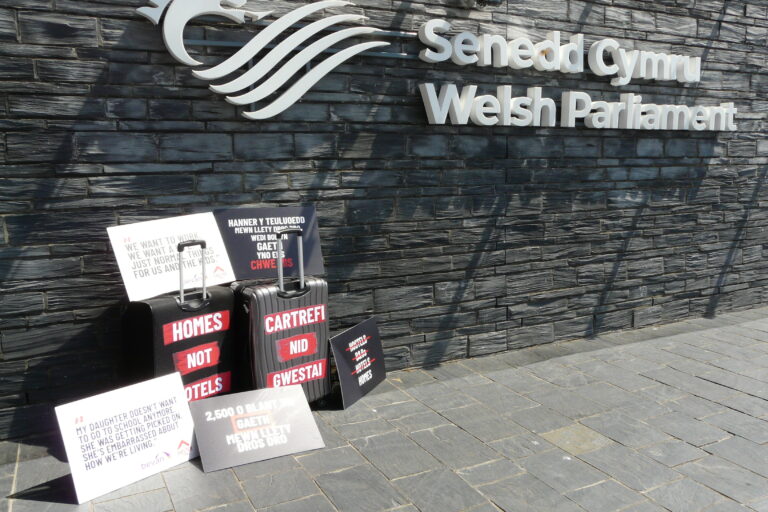
Shelter Cymru has been campaigning for some years with Tai Pawb and CIH Cymru for the internationally recognised right to adequate housing to be enshrined in law in Wales. Here’s a transcript of part of the conversation between Chief Executive Ruth Power and Communications Officer Liz Day about the right to home.
Liz: Am I right in thinking that home is already a human right in international law? Could you talk us through the current picture?
Ruth: The right to adequate housing is a right for everyone to live in security, peace and dignity and it is drawn from the broader right to an adequate standard of living that’s set out in international law. It’s in the UN International Covenant on the Economic, Social and Cultural Rights and that right is supported by an international framework that sets out the different components of adequacy, sets out the principles related to the right and provides some guidance on implementation.
The right includes components like affordability, accessibility, security of tenure, habitability, cultural adequacy – things that might be quite familiar to us. Then there are principles that set out some minimum requirements as well, so governments are required to make maximum efforts to eliminate homelessness, priority should be given to those in the greatest housing need and there’s also a duty to ensure equality and tackle discrimination in terms of access to a home.
It’s a right that’s used internationally to drive improvements in the quality of people’s homes and to end homelessness and many countries have incorporated the right into domestic law. The position at the moment in the UK is that we are bound by that right in international law, but it’s not been incorporated into domestic law, so it hasn’t had very much attention.
Liz: What is the position in Wales and how would you like that situation to change?
Ruth: Well, it’s an interesting position in Wales because we’ve got a broad moral consensus that home is a human right, but that sits rather uncomfortably alongside the housing emergency that we’ve got in Wales.
There’s a host of national data, including data from our own casework at Shelter Cymru, which highlights that people across Wales are living today with the consequences of this international right not being upheld in Wales. We are lobbying Welsh Government to bring the existing international right into domestic law in Wales and we think that would give prominence to home as a human right. And it would require the Welsh Government and future Welsh Governments to make realising this right as a real fundamental and to make it one of the top priorities of government in Wales.
Listen to this conversation on our podcast:
Liz: Why is the right to home so important?
Ruth: Typically, home is seen as an asset and there are still some lingering concepts of who is deserving and undeserving of a home. Using a human rights lens reframes home as an essential. It frames it as a universal foundation for all of our lives, so legislating for home as a human right is providing leadership for a shift in mindset in terms of how we see home. It positions home as a foundational mission of government, like health or education, and something that’s far too important to simply be left to chance or to be left to the market.
It’s a transformative vision. A right to adequate housing is a vision of good homes for all that is underpinned by a legal framework. And that legal framework hardwires the vision into future government priorities and requires governments to take action to realise that right for everyone.
It would give government new responsibilities to develop a long-term strategy for across the whole housing system, backed by resources so that everybody can have a suitable home in the future. It would require governments to consider the right to a home when it makes various policy and budget decisions. It would mean government would be duty-bound to evidence how they’ve considered the right to home when they assess the impact of any budgetary decisions. So it would drive the plan, in that it would drive the investment across Senedd terms that we really need and it would make Welsh Government much more accountable for the decisions that it takes on housing.
It’s probably worth noting that the right to adequate housing informed the approach in Finland, where we’ve seen tremendous progress with Housing First and in ending homelessness. If you look at where we are now in Wales, we’ve got a housing emergency. That’s a really predictable legacy of decades of under-investment, decades without long-term planning in terms of our approach to the housing system, and if we can have a different future, we need to have a real step-change in the priority that governments place on a suitable home for all, and we think that a right to adequate housing can kickstart that transformation.
It’s probably worth adding in the current context that securing the right now feels particularly important because we’re in a less stable political environment. A right in law would give much greater protection to the existing commitments we’ve got, for example, to end homelessness in Wales. So we’d protect those commitments as well as driving governments harder, driving all future governments harder to do more. The right feels really important in and of itself, and it is a real step-change in the way that we would approach things.
Liz: The right to home is one of the key asks in Shelter Cymru’s manifesto ahead of the Senedd election next May. What action would you like to see the next Welsh Government take?
Ruth: Firstly, we’d encourage people to take a look at our manifesto, which sets out our calls for a homelessness system and a private rented sector that are fit for people’s needs, and our call for more social homes at scale and at pace.
We are also calling for a right to adequate housing to underpin these calls to establish a cross-government and a housing system-wide approach to ending the housing emergency. There’s a real opportunity for the incoming government to be bold and put that commitment to universal access to a suitable home at the heart of its programme for government, so we’ll be looking for that next government to take immediate steps towards legislating for the right to adequate housing in Wales, to do that early in their Senedd term and to set out their plans for how they will realise that right over time. As the UN itself highlights, legislating for the right is the first step to realising the right, so we’ll be looking for that important first step and then that follow-through action.
Liz: I understand some countries have already put the right to adequate housing into their own laws. What can we learn from that?
Ruth: Well, we did some research. We commissioned Alma Economics to do some independent research for us with our campaign partners to see what we could learn from countries where the right has been incorporated and they looked at countries as diverse as Finland, Canada, France, South Africa, for example, and there were three key lessons that their report highlighted that we are keen to bear in mind.
The first one is around progressive realisation, so the concept of progressive realisation recognises that there is no quick fix to the situation that we’re in. Progressive realisation requires governments to ensure consistent progress year on year and across government terms, using the maximum available resources, so it’s quite realistic. What it requires is continued progress at a pace that fits the resources available and it requires governments not to fall back in the progress that they’ve made.
The second one was around governance, so ensuring there are really strong mechanisms for holding governments to account to ensure that government policy and legislation and so on is taking the country in the right direction in terms of realising the right to adequate housing and that governments can be held effectively held to account is absolutely critical.
And then thirdly, something we talk a lot about in Wales, is the supply of homes. Recognising that we’re not going anywhere without improving supply. Recognising that supply and the additional investment in supply is absolutely critical to success wherever the right to adequate housing is pursued.
We’ve got those three key lessons and I think, as a campaign partnership, we are very aware that legislation is not, in itself, a silver bullet. Then we’ve got to keep learning from international progress, which is continuing as we speak. That international progress has also shown that sustained political will is really key to making sustained progress in any country. So those are the kinds of lessons that we are bearing in mind and we’ll continue to watch and learn internationally as we pursue the right and when the right is enacted.
Liz: I know you’ve been campaigning for the right to a good home in Wales for some time now with Tai Pawb and the Chartered Institute of Housing (CIH) Cymru. Could you talk us through the Back the Bill campaign?
Ruth: The campaign began in 2019 with Tai Pawb and CIH Cymru and it’s probably fair to say it’s had considerable impact since then. It began its work with a feasibility study by Professor Simon Hoffman into incorporating the right to adequate housing into law in Wales. That was followed by a draft bill showing how that might be done in practice in Wales and at that stage, I suppose, the campaign’s focus was on the moral imperative to introduce the right.
In more recent years, we commissioned Alma Economics to do two pieces of independent research – the review of the international evidence base and a cost benefits analysis. The cost-benefit analysis showed that if we invested £5 billion in implementing the right to adequate housing, ending homelessness and improving homes, that would bring returns of £11.5bn over 30 years. So that very much speaks to the financial imperative of introducing the right to adequate housing.
We have seen government respond to the campaign. The campaign has resulted in Welsh Government publishing green and white papers over this Senedd term, but it’s fair to say that we’ve been disappointed by the limited extent to which these have reflected the international human rights-based approach that we are advocating. But we have, overall, seen the campaign for the right to adequate housing come from the margins to the mainstream and it’s well-supported. We know polling for CIH Cymru showed that 77% of people support a legal right to adequate housing. Around three quarters of housing associations have pledged their support for the right and people like political parties, academics and charities, like the Bevan Foundation, Llamau, Care & Repair, Cymorth Cymru and others have pledged their support for the campaign.
Looking forward, we’re now looking to build cross-party political momentum to deliver that transformative change that we need for the right to adequate housing. And for us it’s all to play for as we look ahead to the Senedd elections. Please do sign up and pledge your support for the right to adequate housing campaign.
Listen to the full conversation on Shelter Cymru’s podcast, Fight For Home, and read the manifesto in our Policy and Research library.
11 December 2025
By Liz Day