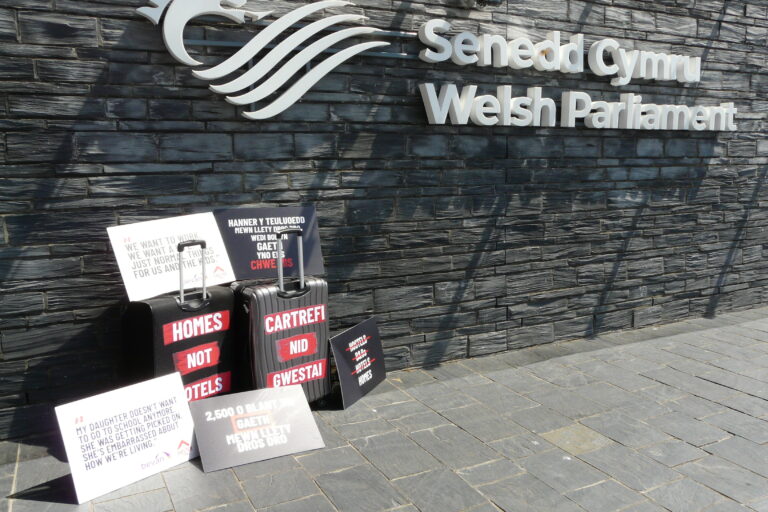
At Shelter Cymru we talk about Wales being in a housing emergency because it is the only language that captures the scale, enduring depth and urgency of the challenges we face. Challenges that include record levels of homelessness, a fundamentally broken private rented sector, housing advice services that are stretched to their limit, and a dire undersupply of the social homes that must sit at the heart of the solution.
We see this emergency every day in the physical manifestations of homelessness, and we feel it in the impact it has on our public finances, our health service, on the education of our children, and the rising housing costs that so many of us have faced.
People are frustrated, and they have every right to be. They see that for too long we haven’t taken the steps needed to tackle the problems we face. Inevitably, people want to know what can be done to change this. But sadly, rather than seeing a focus on those solutions that would most help, we are instead seeing complex issues being reduced to simplistic talking points – many of which see people and communities being unfairly scapegoated and potentially put at risk.
This includes a narrative that the fault for decades of failure to ensure everyone in Wales can access the home they need lies with people who move here for sanctuary or to build a life, rather than our politicians and our housing system. A narrative that overlooks the decades of failure to prioritise building the homes we need and instead asks us to blame our friends and neighbours.
Home is a human right, and at Shelter Cymru we won’t stop fighting until everyone in Wales has access to a safe, secure, suitable and genuinely affordable home.
Hiding behind simple narratives that ignore the true drivers of the emergency we face won’t achieve this. Only a sustained, cross-party commitment to building a housing system that works for all can.
A failure of supply – not demand
Housing is complex. Homelessness is complex. However, the heart of understanding all the problems we face is one relatively simple fact: successive governments, both pre- and post- devolution, haven’t ensured a sufficient supply of homes.
This isn’t just about a failure to deliver raw numbers either it’s about a failure to deliver homes that are well connected to transport links, homes that are properly adapted or adaptable for older people or people with disabilities, homes that are fit for the future and will stay warm, safe homes for decades to come.
Looking at the number of homes delivered each year in Wales since 1946 is a good starting point for understanding this.
The most striking part of this graph is in red, the number of new homes built by councils and other social landlords in Wales each year. This delivery peaked in 1953 at almost 13,500 new homes, with average completions between 1946 and 1980 totaling almost 7,500 new social homes a year.
For context, the last time all completions in Wales (including private sector) were more than 7,000 was in 2008/09.
By 2024/25 overall delivery of new homes had collapsed to 4,630 homes, with just 210 of these provided by local councils and a further 1,060 provided by housing associations.
We have created a system where councils in Wales are delivering just 1.6% of the homes, they could 70 years ago. The consequences of this were inevitable and it’s the reason we’re living through a housing emergency today.
What went wrong?
Understanding the changes to policy and law that led us to this decline in housing delivery can’t be done quickly, and there are many reasons why we haven’t delivered the homes we need. But rather than pointing fingers about the failures of the past 40 years, it’s more helpful to think about what it was that led us to record housebuilding delivery in the past, so that we can achieve this again.
Key to that story is political will and political consensus.
This starts with the post-War Labour Government whose achievements included the creation of the welfare state, the NHS and the beginning of large-scale council housing developments. With the MP for Ebbw Vale and Minister for Health – Aneurin Bevan – famously spearheading this work.
“It has been common ground in all parts of the House, and I believe, in all parts of the country, that the first task for the Government after the war was to try to make war damage good, and to provide homes for the families who had none.” Aneurin Bevan MP, Housing Bill Debate, 16/03/1949
This new commitment to building homes went on to last for the next four decades. With delivery of social homes increasing during the 1950s under the Conservatives. With the 1951 Conservative Party Manifesto helping us to see why:
“Housing is the first of the social services. It is also one of the keys to increased productivity. Work, family life, health and education are all undermined by overcrowded homes.” Conservative Party Manifesto, 1953
The key principle that enabled this decades long success story is simple: that when the focus of our politicians is on building homes then success and change can be delivered. When our politicians instead pursue scapegoating and try to create “villains” for their story, they are moving us further away from the path that we know offers solutions.
For ordinary people in Wales this consensus still exists, with recent polling from Shelter Cymru demonstrating that building more social homes is the most popular policy intervention for solving the housing emergency. And this is true not only in the round but also when we look at the data based on who people are most likely to vote for in a Senedd Election.
Where next?
Looking ahead, if we are to solve the housing emergency, we all need to do more to ensure that the true story of what has led us here is shared widely and frequently.
Beyond that, we can all expect our politicians to be in the business of understanding the true causes and demand that they focus on telling us about the solutions they would bring. Scapegoating is not a solution.
Over the course of this Senedd term, the current Welsh Government has been pursuing its target to deliver 20,000 homes for social rent. We welcome the progress and ambition. Looking ahead to the publishing of all parties’ manifestos in the coming months, this also gives them a place to start from and to set out how they will ensure that Wales can once again deliver social homes at the pace and scale that people across Wales need.