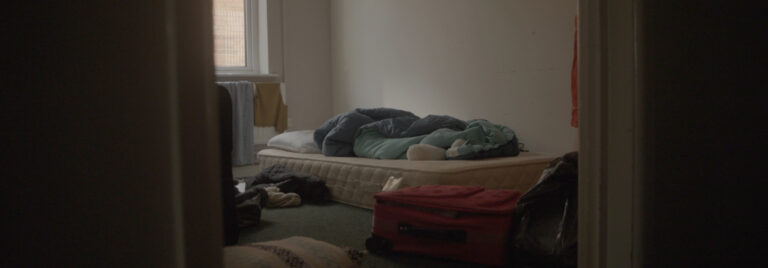
Temporary accommodation is one of the most concerning aspects of Wales’ housing emergency. Shelter Cymru clients have told us about being placed in hotels and B&Bs that are in disrepair, cramped, and come with strict rules around curfews and visitors. People can find themselves cut off from their communities, left with fear and uncertainty.
Shelter Cymru caseworkers hear their stories every day. Far too often, people lack crucial systems of support. Is there someone available to talk to who can offer some help or advice? How do you navigate a system you never dared imagine you’d be forced into?
“It affects your wellbeing, your mental health. I get panicky and then I forget to take my medication because I’m stressed. I can’t keep going the way I’m going. My state of mind is deteriorating”
It is widely understood that people experiencing homelessness are significantly more likely to have experienced multiple traumas throughout their lives. Specialist homelessness support and accommodation options have, to varying degrees of success, educated and trained their staff to work in a way that tailors support to be trauma informed.
But this is rarely the case in temporary accommodation.
More than half of the nearly £100million that local authorities in Wales spend on temporary accommodation each year goes directly to private sector businesses. People are stuck living in hotels and B&Bs with no idea of how long their stay will be, who else will be housed alongside them and what will happen next. If there are staff on site it is more likely to be hotel receptionists or security staff than people able to offer person-centred support. The people living in temporary accommodation are enduring a quality of life that is, by its very nature, traumatising. And we aren’t giving them the support they need to manage this.
“The hotel staff know I’m not well and that I struggle for money so they always tell me to take some extra packs of cereal back to my room. It’s one of the only things I can make for myself in the room. It’s only Weetabix but it’s nice to know that at least someone cares. The human race is designed to care about each other, and we’re getting something wrong”
We see every day the impact that this instability and lack of support has for people.
Shelter Cymru have supported people who have been evicted for anti-social behaviour without any mediation, then denied further help due to the interpretation that they had made themselves “intentionally homeless”. One woman left her job so she could stay in her B&B all day to keep an eye on her teenage children, the apparent source of the anti-social behaviour, only to be evicted anyway.
Shelter Cymru’s Prison Link service has seen 20% of its clients come from temporary accommodation in 2025, many of whom had been recalled. Some clients have a history of poor mental health and substance misuse. They spoke about raising concerns over the type of environment they were being placed in, knowing they had been abstinent, and the potential to relapse and reoffend. Their previous experiences in temporary accommodation have led them to fear their release, based upon where they are likely to end up, and the absence of any support to help them get through it.
“We’ve got drunk people all around us. They’re arguing, they’re fighting. We’re in the middle of that and have to live in that. I feel really vulnerable here. I’m away from my local area. I’m away from my support. I don’t know anyone down here.”
At times, the lack of a proper support structure can give way to a reliance upon punitive processes as a means of managing behaviour and engagement. We lose sight of the human beings experiencing the strain of the housing emergency and, instead of offering support or intervention, we take action that exacerbates trauma and fuels cycles of repeated homelessness.
Acceptance of temporary accommodation as just another rung on the ladder of homelessness is something we must reject. The people who live through it need compassion, tolerance, and hope. It is not enough to just put people in rooms to sit and wait for something better.
It is not enough to provide people with a roof. What they need is a home. One that can offer a safe and stable base for them to build a future from. When we can’t provide this, we have a duty to do everything we can to mitigate the impacts of managed homelessness for everyone caught in this system.
Last week saw the publication of the new Homelessness and Social Housing Allocation Bill. In the accompanying notes, the Welsh Government acknowledge that “long stays in temporary accommodation can result in negative impacts for individuals” and that, alongside changes that will be introduced by the new Bill, “broader practice, policy changes and investment in housing supply” are needed.
It is encouraging to see a progressive drive toward a truly trauma-informed system, but legislation alone can’t make it a functional reality. It will only be possible if Welsh Government and all our colleagues in housing and homelessness are able to put people first and work together to offer the right support at the right time, and for as long as it is needed.