Across Wales we are undeniably in the midst of a housing emergency. With over 11,000 people currently stuck in temporary accommodation, private rents in Wales continuing to rise and tens of thousands of households waiting for social homes.
And those that own their homes are not insulated from the housing emergency either, with mortgage repossession claims at their highest level since 2019. For this reason we need to change how we think about support for homeowners, and recognise that providing the right support for this group is a homelessness prevention measure.
Ensuring a household can remain in their home directly benefits the health and wellbeing of that family but also has wider impacts for Welsh society. In supporting homeowners we reduce homelessness which reduces spending on temporary accommodation, reduces the need for additional support or health interventions, and reduces the impact on the education and employment opportunities for that family.
The Welsh Government has a number of options available to it to help keep people in their homes, whether that’s through helping to address affordability challenges or through social landlords acquiring the home. Right now, these measures aren’t being used effectively and we’re worried about the impact for both households and public finances.
Why are we worried?
Every quarter the Ministry of Justice publishes data on the number of mortgage possession claims brought against homeowners in Wales. The latest update to this data was published in November 2024 and shows that repossession claims in Wales have hit their highest level since before the pandemic.
In the summer of 2024 (Q3: July to September), 390 repossession claims were made. This was a 46% increase from the quarter before and is the highest total for a single quarter since Q3 of 2019.
Fig1. Repossession chart
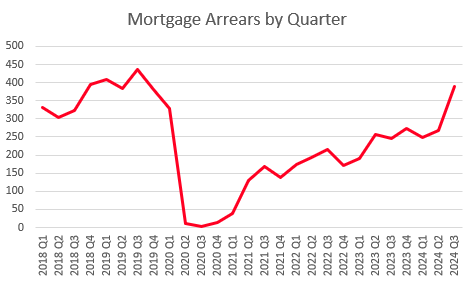
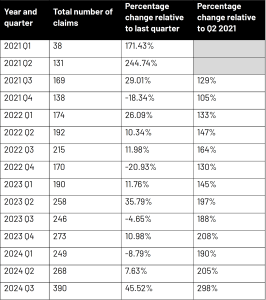
This spike, whilst significant on its own, also seems to be the continuation of a trend that has seen mortgage repossession claims rising since the end of Covid-19 pandemic measures.
Fig2. Number of repossession claims
In addition to the public data on repossession claims we have also been tracking shifts in the number of mortgage arrears cases Shelter Cymru caseworkers encounter. Taking a snapshot of our data from November 2024 we once again see a concerning increase in the number of homeowners struggling and potentially at risk of homelessness.
In this one month we saw 77 cases related to mortgage arrears, almost 8% of our total caseload. In 48 of these the household was experiencing repossession action. This figure also represents the highest volume of cases as a percentage of our caseload over the past year, and appears to show a continuation of a steady trend of growth in recent months.
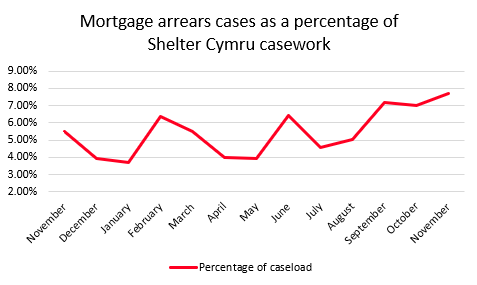
Taken together we believe this data points towards a potential growing problem of affordability among mortgage holders. Something that should perhaps be no surprise given the ongoing cost-of-living crisis that sees day-to-day expenses increasing alongside the continuation of higher mortgage costs than many had become accustomed to.
How can we address this?
Firstly, we need to start by looking at support for homeowners through a lens of homelessness prevention. To do so would change the perspective that many bring to how we address this problem, and would mean more emphasis placed on providing support that sees people remain in their current homes but potentially as social tenants rather than homeowners.
Secondly, we need to review the support that is in place and whether it is effective. This includes looking at the Welsh Government’s ‘Help to Stay’ scheme.
‘Help to Stay’ was launched in November of 2023 with £40 million allocated to provide equity loans to households struggling with affordability. Households wouldn’t have to start paying back these loans for the first five years, helping reduce monthly repayments to a more manageable level.
For some households ‘Help to Stay’ doubtless offers a viable solution, and because the application process includes engaging with debt advice there will be some who apply but are then able to manage their finances without ultimately taking out the loan. However, after a year of operation, it appears that ‘Help to Stay’ is having a significantly more limited impact than the Welsh Government has hoped. In fact, across the first 12-months just five loans were approved from 59 applications.
The reality is that ‘Help to Stay’ isn’t a product that can help those facing severe affordability challenges, or those whose circumstances have changed significantly. For households in those situations Shelter Cymru believes a renewed emphasis on mortgage rescue schemes would have greater impact.
With mortgage rescue, unlike ‘Help to Stay’, the tenure of the household changes, with homes acquired by a social landlord and the individual or family that live there becoming social renters. An approach that can not only lead to lower monthly costs through rent vs mortgage but that also eases any burden of repair or maintenance that someone may be struggling with.
Increasing the availability of mortgage rescue is something we advocated for ahead of the decision to introduce ‘Help to Stay’ in 2023, including in our report Preventing Homelessness for Struggling Homeowners. In this we called for the introduction of “dedicated capital funding for a Mortgage Rescue Scheme across Wales”. Such a funding pot would – we believe – help to supplement existing local authority mortgage rescue schemes and ensure that across the whole of Wales such schemes are available to those who need them.
Mortgage rescue is not a new idea, Wales has previously been at the forefront of using such schemes to prevent homelessness. The data tells us that increasing numbers of homeowners are struggling and are at risk of homelessness. Now is the time for a renewed focus on schemes such as mortgage rescue that can help the homeowners who are most in need to stay in their homes
You can read our full report on mortgage rescue here.
You can also read Amanda’s story here to gain further insight into the impact that mortgage rescue can have on people’s lives.
If you are struggling with mortgage arrears or repossession you can find advice on Shelter Cymru’s website or contact us on 08000 495 495 between 9am and 4pm, Monday to Friday.